


Step-Up Violin, Viola & Cello Guide | StringWorks
One of the most common questions we hear — and one of the most important ones — is some version of this: "My child has been playing for two years. Is it time to step up their instrument?" Or, from adult players: "I've outgrown my beginner violin. How do I know when it's really time?"
The answer matters more than most people realize. Playing on an instrument that's holding you back is a bit like trying to run a race in the wrong shoes — you might finish, but you'll work twice as hard and wonder why it feels so difficult. The right step-up instrument at the right time can be genuinely transformative.
What Is a Step-Up Instrument?
A step-up instrument — sometimes called an intermediate instrument — is the bridge between a beginner outfit and a professional-level instrument. It's designed for a player who has developed real technique and musical sensitivity, and who needs an instrument that can respond to and reward that development.
Beginner instruments are built to be affordable and durable. They do their job admirably — but they have a ceiling. At some point, no amount of practice will coax more tone, projection, or nuance out of them, because the wood, the craftsmanship, and the components simply aren't capable of it. A step-up instrument removes that ceiling.
Signs It's Time to Step Up
There's no single universal trigger, but here are the clearest signs that a player is ready for a step-up violin, viola, or cello:
- Your teacher recommends it. This is the most reliable signal. A good teacher hears things in your playing — and in your instrument — that you may not. If they're suggesting a step-up, take it seriously.
- You've been playing seriously for 2–4 years. This is a general guideline, not a rule. A student who practices diligently and progresses quickly may be ready sooner. A more casual player may be fine on a beginner instrument longer. The instrument should match the player's actual development, not just their years of playing.
- You're working on more advanced repertoire. As music becomes more demanding — in dynamics, tone color, and technical complexity — the instrument needs to be able to keep up. If you're pulling dynamics out of a beginner instrument, you're fighting the instrument rather than making music.
- You notice tonal limitations. If you find yourself frustrated that your instrument sounds thin, lacks projection, or feels unresponsive under the bow, that's your instrument talking. A step-up instrument opens up a whole new dimension of tone and expressiveness.
- You're moving into orchestra, competitions, or serious study. These contexts demand more from the instrument. Peers and teachers will notice — and so will you.
What Changes in a Step-Up Instrument?
It's worth understanding exactly what you're getting when you move up, because the differences go well beyond price:
- Wood quality. Step-up instruments use better-seasoned tonewoods with tighter, more even grain on the spruce top and more pronounced flame on the maple back and sides. This directly affects resonance and tonal complexity.
- Workmanship. The graduation (thickness variation) of the top and back is more precisely executed by more skilled hands. This takes significantly more time and skill — and you hear it.
- Components. Better pegs, fittings, and tailpieces contribute to tuning stability and overall tone. Details matter at this level.
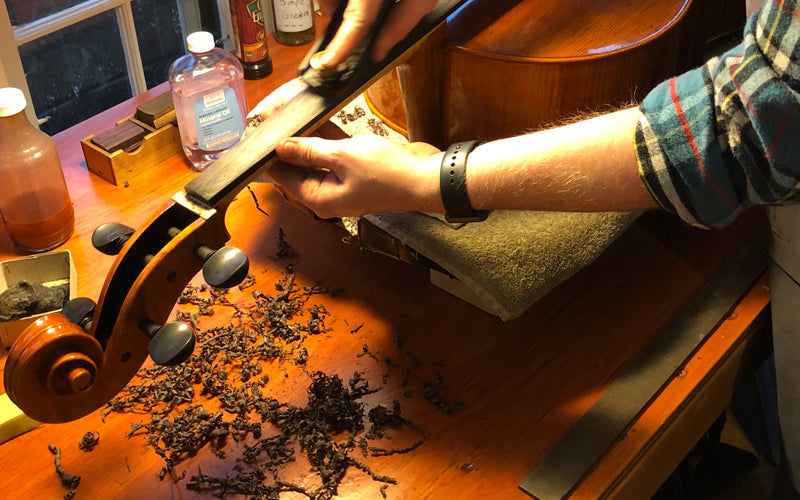
- Setup. A quality step-up instrument should come professionally set up — not factory set up. At StringWorks, every instrument regardless of price receives our full professional StringWorks Setup™, which takes 3–5 hours for violin and viola, and 5–7 hours for cello. This alone makes an enormous difference in playability and tone.
Step-Up Violins: What to Look For and What to Spend
For most advancing students, a quality step-up violin falls in the $800–$2,500 range. Below that, you're still in beginner territory. Above it, you're moving toward professional instruments that may be more than the player needs at this stage — though if budget allows and the player is serious, buying ahead of your level is never a bad idea.
What you're looking for: solid carved top and back (not laminate), quality tonewoods, and most importantly, a professionally set up instrument from a shop you trust. The setup matters as much as the instrument itself — a beautifully made violin with a mediocre setup will underperform a simpler instrument that's been set up with real care.
Our step-up violin recommendations:
- Maestro Violin — an outstanding step-up option with exceptional tonal warmth
- Virtuoso Violin — a step above the Maestro, ideal for the more serious advancing student
- Browse all intermediate violins
Step-Up Violas: A Special Consideration
Viola step-up purchases carry an additional variable that violin and cello don't: size. Unlike violins, which are standardized at 4/4 for adults, violas come in a wide range of body lengths — typically 15" to 16.5" for adults — and the right size depends on the player's arm length, shoulder width, and physical comfort. Never sacrifice physical comfort for a larger instrument. A 16" viola that a player can hold and bow freely will always outperform a 16.5" viola that strains their technique.
Budget range for a step-up viola: $900–$2,500, similar to violin.
- Browse intermediate violas
- Use our sizing guide to confirm the right body length
Step-Up Cellos: Timing and Budget
Cello step-up timing generally follows the same principles as violin, but the investment is typically larger. Quality step-up cellos range from $1,500 to $4,000 for most advancing students. As with violin, the setup is critical — a cello's soundpost position, bridge carving, and string height have an enormous impact on playability and tone, and these are areas where an in-house luthier makes all the difference.
One important note for cello parents: if your child is still growing and may need a size change (moving from 3/4 to 4/4, for example), confirm they've reached full-size before making a significant step-up investment. Our sizing guide can help with that determination.
- Virtuoso Cello — one of our most popular step-up cellos
- Artist Cello — exceptional value for the advancing student
- Browse all intermediate cellos
Don't Forget the Bow
This is the most consistently overlooked part of the step-up conversation, and it's a mistake. The bow is responsible for at least 50% of the sound you produce — arguably more. A step-up instrument paired with a beginner bow is a significant mismatch. Budget for a bow upgrade as part of the step-up process, not as an afterthought.
Carbon fiber bows have become genuinely excellent at the intermediate level and offer consistency and durability that wood bows at a similar price point often can't match. Our carbon fiber bow guide is a good starting point, and our specialists are always happy to help match a bow to an instrument. Browse our bow selection here.
Making the Most of Your Step-Up Investment
A few practical notes that will serve you well:
- Use your trade-in. If you purchased your beginner instrument from StringWorks, our trade-in program gives you 100% of the original purchase price toward your step-up instrument. That's real money — use it.
- Try before you commit. Every StringWorks instrument comes with a 14-day in-home trial. Play it in your lesson environment, in your practice space, in the acoustic conditions that actually matter to you. If it's not right, we'll make it right.
- Buy a little ahead of your level. This is advice we give consistently and sincerely: if your budget allows, buy the instrument you'll grow into rather than the one you've already grown out of. A step-up instrument that challenges you slightly is far more valuable than one you'll outgrow in a year.
- Ask your teacher. Involve them in the decision. A good teacher can tell you what qualities to prioritize for your specific playing style and repertoire goals — and some are willing to try instruments alongside you, which is invaluable.
The step-up moment is one of the most exciting in any player's development. Done right, it's the point where the instrument stops being an obstacle and starts being a partner. We'd love to help you find yours.
Contact our specialists — call (888) 624-6114 or reach out online. We'll ask the right questions and point you in the right direction, whether you're ready to buy today or just starting to think about it.
Explore Step-Up Instruments at StringWorks
Step-Up Violins
Step-Up Violas
Step-Up Cellos
Related Resources
Written by Todd French, Founder/President, StringWorks Inc.